
Teacher Effectiveness Enhancement Programme (TEEP)
“(I enjoyed) having uninterrupted time to think about, engage in and revisit teaching and learning strategies while being introduced to TEEP. This feels like some of the most successful training I have had for some time.”
(Anita Webb, Ysgol Uwchradd Caergybi, Holyhead)




SSAT’s teaching and learning model
If you want to create purposeful, aspirational classrooms, you need to nurture excellent teachers; teachers who present subject matter clearly, promote discussion in learners, check learners’ understanding, identify misconceptions and provide clear unambiguous feedback to move learning forward. In short, you need to enable teachers to identify their own developmental needs to make the small gains needed to be more effective in their teaching.
The Teacher Effectiveness Enhancement Programme (TEEP) is a pedagogical framework and training programme that acknowledges teachers’ expertise and experience, builds a culture of collaborative practice and leads to greater consistency in approach.
By participating, educators gain invaluable insights into evidence-based teaching methodologies that promote engagement, active learning, and critical thinking. TEEP empowers teachers to create dynamic and inclusive learning environments, fostering academic progress and nurturing the holistic development of students.
Embracing TEEP is a transformative step for educators aspiring to inspire and empower their students, leading to improved outcomes and enhanced satisfaction in the teaching profession.
Speak to Andy Williams, Senior Education Lead
We are here to help and support you. Find out more about TEEP or other ways we can help by booking a call now. With their wealth of experience, Andy and his team will be with you every step of the way.
Book a call
Programme Benefits
In an independent evaluation of the TEEP programme, the Centre for the Use of Research and Evidence in Education (CUREE) noted that: “The Teacher Effectiveness Enhancement Programme works to increase the effectiveness of teachers and give them a model and a language rooted in teaching and learning to apply to the classroom’”.
Based on that, teachers who undertake the programme will be able to:
- Improve teaching and learning across your whole school through a single, consistent model.
- Inspire your teachers to reflect on and improve their practice.
- Become motivated learners themselves through a range of creative techniques.
- Drive collaboration and the sharing of best practice in teaching and learning.
- Build autonomy in learners, challenging and developing their higher order thinking skills.
- Receive ongoing support including resources, research and shared ideas as part of the TEEP community.
How does it work?
Embedding TEEP
Selected school staff are identified to become TEEP trainers, studying through an intensive programme of professional development to be able to deliver contextualised training to their own colleagues, supported by SSAT experts and robust materials developed over many years. This ensures that the shift in teaching is both sustainable and scalable, set in the context of your school or college, and acknowledges the unique approaches of each and every teacher.
Download the TEEP Progression document
Consistency not uniformity
The TEEP framework

Click to zoom
The framework operates at three levels:
- Classroom: Teachers use a flexible learning cycle that creates an environment focused on learning, without unnecessary workload.
- Curriculum: The underpinning elements of TEEP ensure teaching is designed to help learners to retain and recall content over the long term, integrating knowledge into bigger concepts.
- Whole school / college: Effective learner behaviours are nurtured to ensure knowledge, skills and attitudes to learning are developed holistically.
Who is the programme for?
TEEP is a whole-school approach to teacher professional development that brings together teachers from all subject areas to reinvigorate their collective approach to teaching and learning. It is suitable for schools in all settings and phases.
‘The programme is aimed at teachers across all levels of their careers and at all academic levels, with the aim being to get every teacher working towards delivering a consistent level of high-quality teaching.’
How to get involved
The TEEP programme can be delivered flexibly and adapted to your school’s requirements. Every school or college has their own unique needs, so the starting point is a free, no-obligation call, so you can expand on your context, discuss potential solutions with an SSAT expert and start planning for teaching and learning improvement.
Find out more and enquire today
Becoming an SSAT Delivery Partner
Being a TEEP Delivery Partner enables your school to become a hub of excellence for TEEP.
It presents an income generating opportunity for schools under a franchise agreement and provides opportunities to raise your profile through SSAT events, publications and social media as well as recognition for the hard work of staff and students to improve teaching and learning.
Register your interest in becoming a delivery partner
Programme Leader
Andy Williams has substantial experience of providing high quality training and support for schools and school leaders, based on his extensive experience in the fields of teaching and leadership. Working with school leaders as programme leader for the TEEP and Lead Practitioner Programmes, Andy is consistently evaluated as excellent recognising his ability to design and deliver inspiring, impactful and highly focused educator training.
Passionate about the transformative potential of education, Andy has proven impact at a strategic and operational level through providing high quality training and support for schools across all settings.
Date and location
In-person
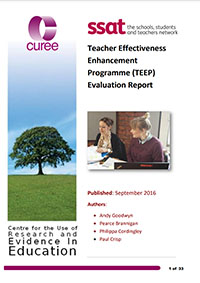
TEEP CUREE Report
In October 2016, CUREE (Centre for the Use of Research and Evidence in Education) undertook an extensive evaluation of TEEP.

Any questions?
Contact us or call 020 7802 0955.
Get in touch
